Showing posts with label aztec. Show all posts

Friday, 6 December 2013

Term Summary

This hasn't been the best term for me. Being without the laptop for 2 weeks, really affected my ability to produce digital work. I tried to create as much hand-drawn as I could, from storyboards, to character designs and the colour script. But it still left me unable to do alot of what i wanted to test out. There were things I will have to do over the christmas break when I planned to do them in term, such as buying a model skull and attatching tracking markers to it, then applying cgi elements to them. I have managed to experiment the last 5 days in CGI tracking in Nuke and Maya, for the technical skills unit.

In some ways it was quite fun to do everything by hand. But being unable to open my files on the college computers due to different software versions was very frustrating. I've also found it really hard to organise my time.


My schedule has been sporadic as I've havent known what to focus on at what time, the idea was far from realised until late into the term and it was hard to work on any creative aspects before that was nailed down. However I've done my best from what's happened and I feel more confident to begin the second term. Probably with a backup computer. 


Thursday, 5 December 2013

Filling out the storyboard


The entire project is now storyboarded.

 I gave Emma drawings like these for her to do her concept art around.

Animatic

James has worked really hard to produce this animatic in time for the presentation. There are areas i would like to improve to get a better feel for but this might have to do for now because of time pressures with dissertation.

Museum Updates and tests

Went to the British Museum today to survey it, it was a darker day which was good to see the inside. After learning about the motion tracking. I'm doubting if the Aztec room is the best place to try and film. It would be ok if we are able to bring in lights of our own but I doubt this would be acceptable to the museum. There are other locations in the museum which would be high contrast enough for us to track or bringing in blue tacked tracking markers might be another idea. The lighting in the room and masks is so low it was hard to get decent photos with a 50mm lens at 1.8 on a 5D with an iso of 1000. I got some footage to try and track which i will do later.


The room was too busy to take a HDRI which I had planned to do. But I at least got these photos of one of the masks. 

Talks about filming in the British Museum


I decided early on I wanted to film in the british museum. I think if we could pull it off it would provide a brilliant filming location. I had an email discussion with someone who works to provide access for film crews into the museum. They require a fee to accommodate this.

Wednesday, 4 December 2013

Aztec Characters


I wanted the same for the Aztecs as I did for the conquistadors. Normal proportions. 

I created these designs. 


Then gave the Aztec design challenge to James. 

Conquistador Characters

I decided to design some conquistador type characters quite early on. I wanted them to be well proportioned and quite un-stylised. This would keep them as distinct characters from the God Quetzacoatl and also, ungodly. Which is important for the story. My first inspiration for the look of these characters came from historical illustrations.
http://upload.wikimedia.org/wikipedia/commons/f/ff/Conquistador_Pedro_de_Alvarado.JPG


I really liked the symbolic aspect of the morian helmet and thought it was an important thing to apply to my own characters. 


Another big influence was Werner Herzogs film Aguirre, The Wrath of God. I then experiemented with different shapes for characters 


And cartoony looks. 


Before settling on something a little less humorous. I still think the design could use some more realism injected but I'm happy with the proportions, so perhaps the refining could be left until modelling as I dont really have more time for it now.


Sunday, 24 November 2013

Colour Script

After sorting out the shot order and script. I worked on a colour script for the film. As I am still without computer and after seeing "The Incredibles" colour script, I thought it would be interesting to do this by hand. I cut out 16x9 images from a magazine and sorted them into the order.


This shows the transition from the museum to the aztec temple, to the storm, to the fire and then to the forest and back to the museum again. 


Tuesday, 19 November 2013

laptop disaster

Before the weekend my laptop died. This means I am having trouble updating my blog and getting computer work done. It is being repaired at the moment and I hope to have it back soon, in the meantime I am trying to use the computers in college.

Lens Choices

After looking at the different lenses. I think I will need a distortion free wide angle lens (maybe a 35m) for filming inside the museum. Aswell as something like an 70-85mm for close ups. Professional cinematographer and lighting engineer Barry Gross recommended a very wide angle lens which has minimal distortion available to rent from;

http://www.vintagelenses.com/


Wednesday, 13 November 2013

Lenses etc 2


28mm


135mm

In this next experiment I was looking at the way focal length distorts at different distances. As you can see 28mm is quite distorted and fish-eye at this close distance where as there is very little distortion from 135mm. 

Lenses ect


For part of the research into cinematography i have been looking at lenses and their uses, Today I have been experimenting a bit with the distortion and differences between lenses, to inform my decisions about ones to use for my project.


This first image is my living room table with some assorted objects. Using a 28mm Lens on a Canon 550d. The 550D is a cropped sensor, meaning smaller than 35mm. Canon don't actually tell you that because they don't want to sound weird. Unless you buy a lower spec EFS lens, The 550d will magnify any lens you put on it and make its focal length meaningless. 


Here is the 28mm on a Canon 5D with a full-frame sensor. As you can see, much more rubbish is revealed at the side of the frame. 


Lifeline

I was beginning to really get disheartened with coming up with a way to link the whole project together. I spoke to my tutor and he gave me good advice. Going the other way with the project and having humour in live action interspursed with the rest. Makes a lot more sense to me.


by using the masks in the museum as the narration I can really link everything together and still make it original and not cheesy or overly dramatised. 


Greenscreen Day

We rented out Room 308 to do some green screen and filming tests. This is important for me as I've never done any filming before on the 5D and its useful to test this out before doing the live action next term. 


Character Designs


I have been trying to design the character of Quetzacoatl.  By examining the various forms he takes in art work and then creating my own design with other inspirations. 


Looking at the stone sculptures has inspired me to turn the character into 3D


The codex images where difficult 


This He-man toy interests me as a combination of snake and human. As the name "Quetzalcoatl" means 'feathered serpent' 


But I need to avoid creating a character that looks like a dragon. 


I created sketches about how to create something human and serpent like, based on the stone sculptures. 


I finally settled on 


New Designs

The temple design was something I did again over summer, I like this design but think it could do with being more realistic to fit in with the rest of the characters. I think the temple is a character in the film as it is one of the only environmental things we plan on modelling. 


I found this model on google-sketchup archive which will do for now. 


Mr DNA from Jurassic Park has got me thinking about how we could make the narration funny. This could cut out a lot of problems. 


Tuesday, 5 November 2013

Films I admire for cinematography.


Being the director I needed to get an idea for the cinematography of the film.
I thought it might be good to look at a few of my favourite movie shots and decide why I like them so much.


Although we are now used to widescreen, the more square format of 4:3 was used until about 1953 where Cinemascope began to take over. A Streetcar Named Desire came just before the transition, it used strong close-ups and low contrast film but is still very sharp.
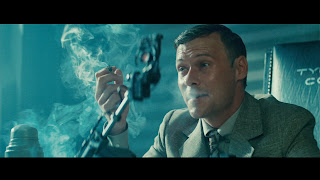


I find Blade Runner pretty much fascinating on every single level. The cinematography is high contrast with lots of blacks. The grain is high so I would guess a high level ISO film was used.  I found out the camera used on this film was a Panavision Panaflex Gold which was a popular camera throughout the 70s. Film used was EASTMAN Color Negative Film 5247. That doesn't mean much to me at the moment. I don't really understand how film cameras are able to film in such low-light and still have the clarity they do. Jordan Chronenweth was the cinematographer here, but considering this is such an iconic film, he didn't really work on anything else noticeable. This may be because Ridley Scott had such a vision for the film. Colours are lots of blue hues and vibrant neon.


I don't know that many people would call 'Jurassic Park' a piece of cinematic art. But I would argue that it is. It wasn't until I looked up the cinematographer for it that I found out Dean Cundey has been the DOP on many of the films I enjoy the most. Back To the Future, Escape From New York, The Thing, 


Another most recent film I love is 'There Will Be Blood.'  The cinematography there uses a lot of wide angles and the colour is a subdued palette of earthy tones. This was again filmed using a more modern version of the Panavision Gold camera. I'll include what film was used, Kodak Vision2 50D 5201, Vision2 200T 5217, but again i have no idea what any of that means in regards to the finished image. 

I like the use of wide-angle lenses in alot of these films and I think framing is very important. I want every frame in my film to stand by itself as something interesting to look at.